
 Roel Schiphorst
b43a42d0d2
BlueMark db200: add LED status and set ESP GPIO pins to enable CAN transceiver chip
Roel Schiphorst
b43a42d0d2
BlueMark db200: add LED status and set ESP GPIO pins to enable CAN transceiver chip
|
3 lat temu | |
|---|---|---|
| .github | 3 lat temu | |
| RemoteIDModule | 3 lat temu | |
| images | 3 lat temu | |
| libraries | 3 lat temu | |
| modules | 3 lat temu | |
| releases | 3 lat temu | |
| scripts | 3 lat temu | |
| .gitignore | 3 lat temu | |
| .gitmodules | 3 lat temu | |
| BUILDING.md | 3 lat temu | |
| COPYING.txt | 3 lat temu | |
| README.md | 3 lat temu |
README.md
ArduPilot RemoteID Transmitter
This is an implementation of a MAVLink and DroneCAN OpenDroneID transmitter. It aims to provide a transmitter solution for the FAA standard RemoteID requrement, meeting the transmitter component of the ASTM F3586-22 Means of Compliance.
Hardware Supported
The firmware cuttently supports the ESP32-S3 and ESP32-C3 chips. There are 4 boards supported so far with more to come:
- the ESP32-S3 dev board: https://au.mouser.com/ProductDetail/356-ESP32S3DEVKTM1N8
- the ESP32-C3 dev board: https://au.mouser.com/ProductDetail/Espressif-Systems/ESP32-C3-DevKitM-1
- a Bluemark BD110 from https://bluemark.io/
- a Bluemark BD200 from https://bluemark.io/
Hardware from https://wurzbachelectronics.com/ is expeced to be added soon.
For the ESP32-S3 dev board the pins assumed in this firmware are:
- UART TX on pin 17
- UART RX on pin 18
- CAN TX on pin 47
- CAN RX on pin 38
For the ESP32-C3 dev board the pins assumed in this firmware are:
- UART TX on pin 3
- UART RX on pin 2
- CAN TX on pin 5
- CAN RX on pin 4
For CAN a suitable 1MBit bxCAN transceiver needs to be connected to the CAN TX/RX pins.
You can also do MAVLink on the USB UART port (the one marked "UART" on the silkscreen). That allows for easy simulation testing by plugging in a micro USB cable.
See board_config.h and Makefile for information on porting to new boards.
Transmission Modes
This firmware supports the following transmission modes:
- WiFi NAN (Neighbour Awareness Networking)
- Bluetooth 4 Legacy Advertising
- Bluetooth 5 Long Range + Extended Advertising
Protocols
This firmware supports communication with an ArduPilot flight controller either using MAVLink or DroneCAN.
For MAVLink the following service is used: https://mavlink.io/en/services/opendroneid.html
For DroneCAN the following messages are used: https://github.com/dronecan/DSDL/tree/master/dronecan/remoteid
The DroneCAN messages are an exact mirror of the MAVLink messages to make a dual-transport implementation easy.
Releases
Pre-built releases are in the releases folder on github
Flashing
To flash to an ESP32-S3 board use the espressif FlashTool from https://www.espressif.com/en/support/download/other-tools
if this is the first time flashing the board, you may need to hold the "boot" button down while attaching the USB cable to the USB connector marked "USB"
and then use the pre-built binary in the releases folder to flash using the following options, after selecting the COMM port that the board is attached:
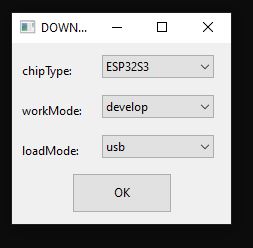
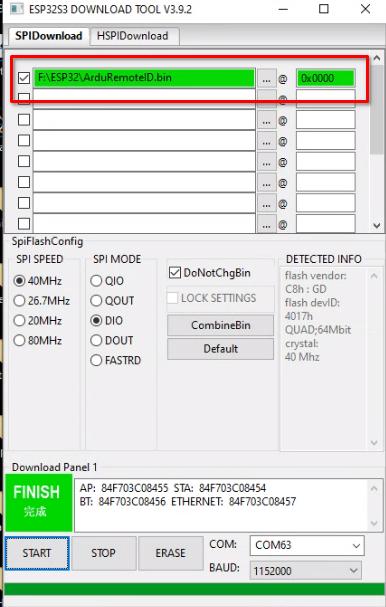
subsequent re-flashing of newer releases should not require holding the "boot" button during power-up of the board as the USB cable is attached.
ArduPilot Support
Support for OpenDroneID is in ArduPilot master and is pending for addition to the 4.2.x stable releases. You need to enable it on a board by setting "define AP_OPENDRONEID_ENABLED 1" in the hwdef.dat for your board.
Credit
Many thanks to the great work by:
- OpenDroneID: https://github.com/opendroneid/
- Steve Jack: https://github.com/sxjack/uav_electronic_ids
- Roel Schiphorst: https://bluemark.io/
- David Buzz: ESP32 CAN and bluetooth drivers
This firmware builds on their work.
License
This firmware is licensed under the GNU GPLv3 or later